
Reframing Good Friday: From Scapegoating to Restoration with Mako Nagasawa

We all know what it feels like to scapegoat—or to be scapegoated. To shift blame, protect ourselves, and make someone else carry what feels too heavy to hold. So what does that have to do with Good Friday?
In this episode of the Allender Center Podcast, Mako Nagasawa helps us see that what we call “scapegoating” today is actually a distortion of its original biblical meaning. Looking at Leviticus 16, he explains that the scapegoat was never about blaming or punishing a substitute, but about removing what didn’t belong. A way of naming that the problem isn’t who we are, but what has taken hold within us.
But over time, we’ve changed that meaning, looking for others to carry the blame instead of facing our own sin. This episode invites us to see the cross differently. Rather than reinforcing blame and punishment, Jesus steps into our cycle of scapegoating to break it, revealing a God who is not looking for someone to punish, but is committed to restoring what’s broken.
This is the hope of Good Friday: not a story of blame, but the beginning of restoration.
About Our Guest
Mako Nagasawa is the Founder and Executive Director of The Anástasis Center. Mako grew up in Cerritos, CA and went north to Stanford, where he studied Industrial Engineering and Public Policy, with a focus on education. He worked at Intel Corporation for 6 years while serving a Spanish-speaking ministry to Mexican immigrants in East Palo Alto, CA. He married Ming in May, 1999 and moved to Boston, MA. He then worked for two startup companies trying to bring technology and jobs to inner city communities. Since 2000, Mako, Ming, and their two children John and Zoe have lived among friends in a Christian intentional community house in a Black and Brown neighborhood in Dorchester.
Mako did campus ministry with InterVarsity Christian Fellowship from 2001 – 2014 and founded The Anástasis Center in 2014. They worship at Neighborhood Church of Dorchester where Mako serves on the Elder Team. He earned a Master of Theological Studies from Holy Cross Greek Orthodox Seminary in May 2019. In addition to Christian ethics, theology, biblical studies, and early church history, Mako enjoys photography, food, tea, and stories from around the world. He misses the Pacific Ocean.
Special Offer for our Listeners:
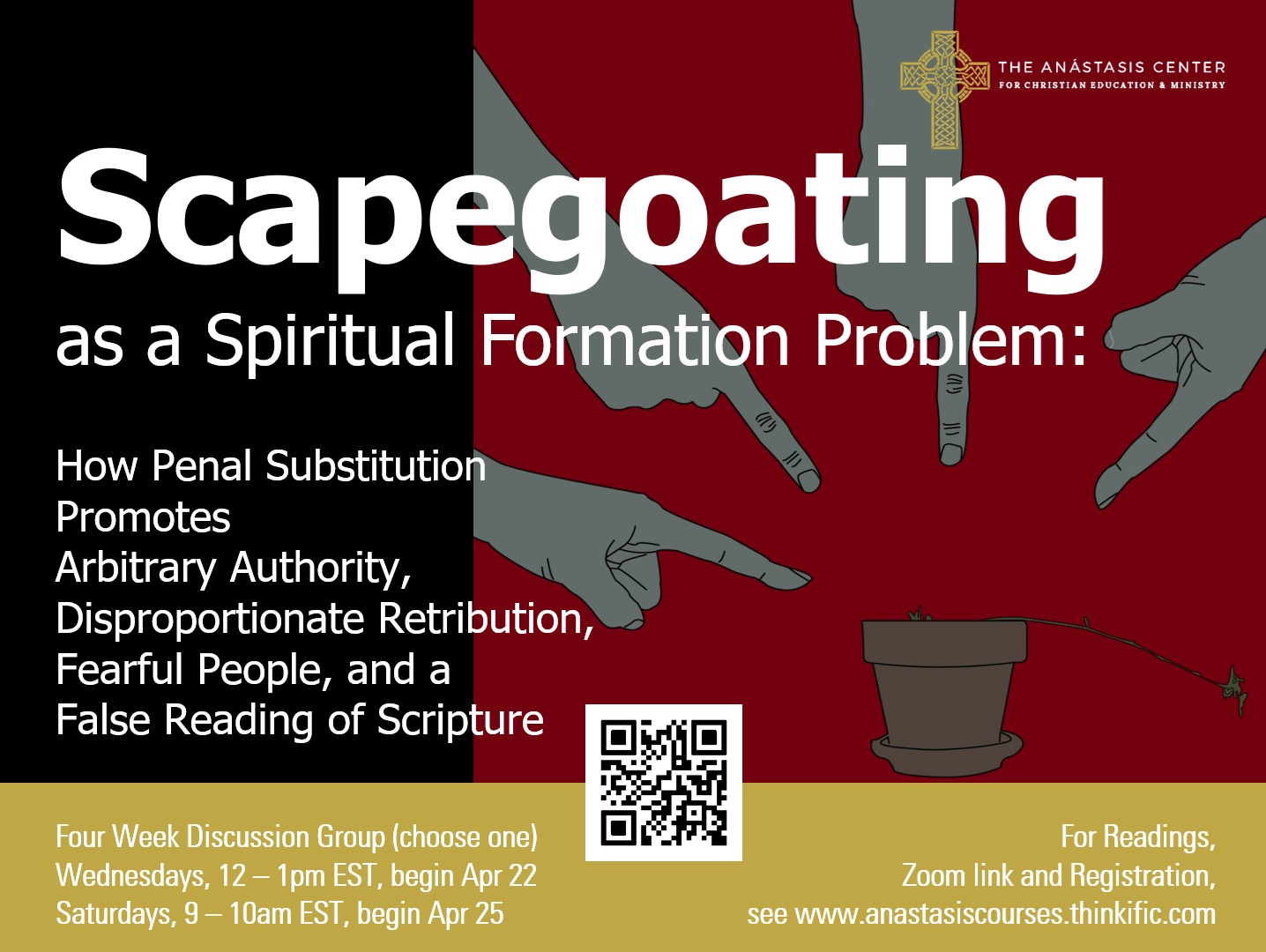
Scapegoating as a Spiritual Formation Problem: A free, four-week discussion group led by Mako Nagasawa with The Anástasis Center.
Explore how Penal Substitutionary Atonement theology encourages people to accept arbitrary authority and deploy harsh retributive justice. Explore how Medical Substitutionary Atonement theology from Early and Eastern Christianity can heal our souls, relationships, and public witness.
Enroll for free (with donations) at: https://anastasiscourses.thinkific.com/courses/scapegoating
About the Allender Center Podcast:
For over a decade, the Allender Center Podcast has offered honest, thoughtful conversations about the deep work of healing and transformation. Hosted by Dr. Dan Allender and Rachael Clinton Chen, MDiv, this weekly podcast explores the complexities of trauma, abuse recovery, story, relationships, and spiritual formation. Through questions submitted by listeners, stories, interviews, and conversations, we engage the deep places of heartache and hope that are rarely addressed so candidly in our culture today. Join the Allender Center Podcast to uncover meaningful perspectives and support for your path to healing and growth.
At the Allender Center, we value thoughtful dialogue across a wide range of voices, stories, and lived experiences. In that spirit, our podcast features guests and hosts who may hold differing perspectives. The perspectives shared on this podcast by guests and hosts reflect their own experiences and viewpoints and do not necessarily represent the views, positions, or endorsements of the Allender Center and/or The Seattle School of Theology & Psychology.
To become a supporter of the Allender Center Podcast, click here.
If you and your organization would like to partner with the Allender Center Podcast, please reach out to Clay Clayton at cclayton@theallendercenter.org
Episode Transcript
Dan: Rachael, I’m going to talk about our guest, even though the guest is on the screen with us. But I want to tell you about my first real encounter with Mako Nakasawa. And it was at a conference, beautiful conference. Beautiful people. ICAP, the International Christian Alliance on Prostitution that Becky and I had been part of since around 2002. This is one of those painful moments where someone got up to talk and it was lovely, but it was 10 minutes of some of the most compelling, brilliant, thoughtful, human analyses of something of the current realm we live in and why the Gospel is so compelling. So the reality of having Mako here. Mako, thank you for joining us. I’m going to introduce you more in a moment, but I just let you say hello before I say more.
Mako: Thank you, Dan and Rachael. Those are very kind words. I really appreciate it and thanks for the invitation to be here.
Dan: Well, we are so thrilled. You are the Founder and Executive Director of the Anastasia Center in Boston. And just to let people know that Anastasis is the lovely Greek word for resurrection. I don’t generally look at websites, but I just looked at yours and this statement of purpose just felt like, wow, it is lovely. We proclaim the restorative justice of God and the healing atonement of Jesus. Well said, friend. Well said.
Mako: Thank you. I’m glad you like it. I mean, most people get confused or they’re like, “What are you talking about? ” But thank you very much. It means a lot to us.
Dan: And I can’t imagine anyone that we would rather have on today as we’re moving into talking about Good Friday and what it means, what it holds for us for you to enter into this Yam Kippur, this day of atonement. And I don’t know a better way to begin other than to say, as you approach Golgotha and what this day holds in terms of a Biblical narrative, but as well, just your life and your work at Anastasis, what do you do with this day?
Mako: Well, it certainly is a holy day. And I draw from the early and Eastern church and I love epic stories. So those two things kind of converge. There’s a perfect convergence between them here. So I approach Jesus as the epic hero and Golgotha is his greatest moment of victory, like a victory, not him as a victim of some sort, but a victory. And John’s gospel, I think is the clearest on that theme for different reasons, the theme of glorification and such. But I think we do see that also in Matthew, Mark,and Luke, as well as Paul and Hebrews. And basically it’s just that at his death, Jesus is victorious over sin in a complete and final way and a decisive way. And he will soon be victorious over mortality or death completely in his resurrection. So I just hold those two things together and say they go together. And if you’re a … We were just talking backstage about if being a fan of the Lord of the Rings. And I think of Jesus as if he’s Frodo, if Frodo had actually cast the ring into the fire, you know what I mean? If he had been victorious, that would be like Jesus. And just for our audience, it’s that Jesus lived the life we should have lived and died the death we should have died, a life of complete faithfulness and love unto the Father. And then in relation to the sin sickness, he resisted it throughout his whole life. He resisted, of course, the evil external to himself, but most importantly, the evil internal to him because he took up fallen human nature in his incarnation to share in the same human nature that you and I have, like to be human and to resist the sin sickness that you and I have, but in a faithful way. And so no one could defeat that except Jesus. And so like an epic hero, I think of Jesus at Goldgotha as he’s killing the thing that’s killing us, right? It’s the sin sickness and he succeeded where everyone else failed. So I wrote a couple small little devotional books on Iraneus of Leon, the second century leader. And he said, Jesus died to finally conquer sin as one of us, which is given the fall, it’s the human vocation. And so when I think of Jesus saying, well, I could call 12 legions of angels to destroy all the people who were mocking me and opposing me. That’s a temptation. He felt that on some level, but he did not give in to the temptation to do that. Instead, he could just continued receiving his identity as beloved child from God the Father. And he lived in hope of resurrection that he would be vindicated as purifying his human nature and bringing forth a God-soaked, God-drenched new humanity so he could share himself with us. That’s how I think of Good Friday.
Dan: I love it. Well, just even hearing it, it’s like living in the Pacific Northwest in a sunbreak after days of something of the cloudy, dark, cold. And all of a sudden, just even in the words you’ve spoken, something of the breath, the warmth of the sun comes.
Mako: Absolutely. Not like the slow snow melt of the northeast of Boston. Just the sudden decisive break. Yes.
Rachael: Yeah. I’m just thinking about how this day … I loved that language of living into his identity as the beloved child of God the Father because I grew up in a tradition. We didn’t really practice Lent and Good Friday always held basically instead of like, oh, acknowledging sin sickness and focusing our eyes on the one who is for us. It was basically like, you killed God with your sin. You are a sinner. You couldn’t take communion. It was like actually one of the few times we took communion, I think usually maybe there was a once a month community service, but Good Friday was always like, You need to think about your sin before you even put your… Instead of like, “You really need this meal and you need to come to this table again and again and again, and you’re welcome here. And it was certainly focused much more on the wrath of God in this day. And we can talk, we don’t have to go down that path. We could talk about a lot of things, but in some ways just that very… Yeah, I mean, penal substitutionary atonement in the context I was in as the only metaphor for atonement. And when I came to the Seattle School, I did a lot of… because I was like, so listen, I’m just a rule follower. And they were like, take your deepest theological questions and your life stories and your vocational hopes and write a 25-page paper on them. And so I was looking more at how do we understand what it means to love in light of atonement? Because if atonement is really showing us, if this day is showing us, what does it mean that Jesus loves us and we are to follow in that way? So this has been, for me in my life, especially in my adult life, getting to lean into Good Friday in some much more, I would say, liberating ways that don’t sidestep death. And so just from afar, what I’ve seen of you, Mako and your work, you’re someone that I go, oh, I want to hear more from Mako around atonement as I continue to learn and kind of reimagine or wrestle with certain theological imaginations I’ve been given. I would just love to hear more from you on how you play with atonement. Yeah.
Mako: I think to start off with that there’s a wrath of God and that can be understood in the kind of Western punitive retributive model, but again, I think it’s just more biblically accurate to understand it in the early and Eastern medical restorative model. And so does the surgeon have wrath? Well, yes, against the cancer in our bodies because the surgeon loves us and is on our side. So of course, if there is something to be removed from us, then there is a wrath, at least of some sort, because there’s an opposition that God has towards the sin sickness, but it’s a wrath that is actually motivated by love for us. So I think that in Western theology, there’s a tendency to conflate human personhood and human nature and the sin sickness in human nature as if it was all the same thing so that the wrath is direct. God’s wrath is understood as it’s as if it’s directed at your personhood. I take great objection to that. And I think the early and Eastern Christians would as well, if we had them here, but we don’t. So I’m just going to speak for them and say that, no, that’s absolutely wrong that God is wrathful against the sin sickness and that’s why Jesus came to die as a victor over the sin sickness, not a victim of the punitive retributive justice of God. And once we understand it that way, I think everything lines up. What is circumcision of the heart? In the Old Testament in Deuteronomy 10:16, it’s just kind of a summary statement that says, look, if you internalize the commandments of God deeply enough, you’re going to cut something away from your human nature that never should have been there. And so that was ancient Israel’s vocation. That was their calling from God. They did make great strides. They hoped for the cure. They diagnosed the disease. They documented it in what the Hebrew scriptures, what we call the Old Testament, but they recognize that, but we can’t fully internalize the doctor’s prescription. So these commands are good for us. They’re not against us and they’re against the sin sickness. So everything that Paul says in Romans seven about his experience as Saul of Tarsus, he’s like, well, I came to realize there’s a part of me that loved God and wanted God and wanted to obey God, but I do the things that I don’t want to do and I don’t do the things I do want to do because there’s something else living in me that God didn’t put there, but we’ve inherited some fallenness and it doesn’t mean that everything about me is bad. Actually, the core self remains good, but there’s this parasite in me. So who’s going to free me from this parasite or the body of this death And it has to be done with a human being and human partnership with the Holy Spirit. And so that’s Jesus, right? He became the perfect patient. He succeeded where Israel could not and he internalized the medicine or the doctor’s prescription to become the cure. So I mean, that’s how I think about atonement and the life, death, resurrection of Jesus and how all these things kind of hold together. So I really do resonate with you, Rachael. There is a disturbing sense of, but if the wrath of God is only directed at our personhood, then does God just care more about how he feels than about how we are? And you get into those spaces.
Rachael: Yeah. And it starts to really mirror the cycle of abuse, right? Yes. Especially the narcissistic cycle of abuse because it’s like, I need to pour out my wrath on you in order to assuage my wrath. It’s going to kill you, but once I do that, then I’ll be restored to an equilibrium and I can rescue you and pour love out on you until I’m wrathful again. Again, not saying that’s … I’m not putting that all on what a certain metaphor means, but I love your playing with, well, there is a very Western view that sees this as more punitive. I don’t know if I’ve ever heard anybody bring a medical restorative model. That makes so much sense to me. It feels just really clear. So I’m grateful. I love that.
Dan: At some point over hours together, I kind of want to step into where some of the shift occurred, maybe a little bit with Augustine, but we’ll hold off a sense of the incredible value of church history here, but what I want to knock on the door of it with your understanding again of the atonement, how you engage the category of scapegoat. And particularly, again, the word scapegoat probably didn’t get used until William Tyndall in the 16th century prior to that, everybody was trying to make sense in the Leviticus 16 passage of Azazel. Who is this dude or place? Is it a demon? Is it a location? Is it the actual goat that’s going out? But just to remind people, we’ve got two goats. One goat that’s blood is put on the presence of Yahweh. And then another goat that’s sent outside the city gates, outside in some sense, Golgotha and beyond. Assuming that this goat would go to or is a Azazel, let’s just say that there’s plenty of information that we’re not going to cover as to the different possible meetings and where all this might land, but what at least we can say is the notion is it’s a sent out, it’s beyond it’s going away. So scapegoat, at least in our world, if I were to talk about scapegoating or scapegoat, very few people know of the Leviticus 16, but most people know it from the standpoint of being blamed, of taking responsibility for and being held in a way that in one sense you don’t deserve. So just to step into this important category, because so much, at least in my reading and listening to your courses, scapegoating is such an important category to understand racial trauma, racial injustice, to understand something of even the polarization of where we are culturally. And darn it, it’s also for a lot of people they experience in their own family of origin. So all that to say, lead us.
Mako: Oh gosh, there is so much there and it is … Well, and it is so good to be kind of holding together biblical interpretation and then the practical outflowing of whatever we decide about these texts and what they mean. And then what kind of formation in us does that seem to cause? And therefore, what kind of choices do we make both as a church or as Christians and as a body politic? And I think it’s deeply trouble. It’s all so troubling. So I think that the irony is that scapegoating in the Bible is the exact opposite in a meaning of what scapegoating is like how we use that English word today. And so I would take Leviticus 16 as kind of the last stage or the high point of a rhythm that Israel had every year. And so it’s meant to be thought of as like, what happens every year because Yom Kippur is annually. And so basically it was that God is acting like a dialysis machine. He comes in the midst of Israel. And again, I know medical and surgical metaphors here, but I think that’s really accurate. He acts like a dialysis machine saying, you bring me your impurity and I will give you back purity or purified life. And so in that way, it is, let me give a little back more background and then the implication about guilt and shame and impurity and all those feelings and realities that we deal with. I think the background is actually the… Every year when the high priest went into the Holy of Holies, he was repeating or retelling the story, the epic story of Moses going up to the high point of Mount Sinai. And so you see these Mount Sinai had three levels because in Exodus 19, God said, “Hey, Israel, I want you to come up here and meet me.” And they said, “No, no, thanks.” We don’t like the look of that fire. We don’t want to be purified apparently, and we don’t want to hear God’s voice too clearly. So instead, Moses went up there. And there are eventually these three levels in Exodus 24, Moses goes to the top and he goes in Exodus 33 and 34 to restore the broken covenant because by that point, like the golden calf incident had happened and God is like, I don’t know if this covenant thing is really going to work. I don’t even know if these are my people. And so he calls them your people, Moses, and it’s fascinating. So essentially Moses goes up to the… He passes through divine fire, enters the glory cloud and sees God in a sense more face-to-face or more face-to-face than anyone else previously. So I know there’s some questions about that, but essentially he repairs the covenant and then Israel can benefit from it. And he comes back with purified face or transfigured face or the light of glory shining in his face, which shows that God, like to repair the Sinai covenant, he didn’t need to have someone be punished. He needed to have someone be purified. That’s what keeps the covenant or in the Sinai covenant case. And so the three sections of the sanctuary, the tabernacle and then the temple mirror like the base, the middle and the top of the mountain and the movement of the high priest into the horizontal space of the Holy of Holies retells the story of Moses’ vertical ascent to the top of Mount Sinai to bring all the impurity to God so that it might be done away with. And so the scapegoat is just the two goats, the two sides of one coin where God is basically saying, bring me, this is the last stage. Bring me the impurity. I will consume it myself and also send it away. So the scapegoat is the part that is sent to the goat that bears the sin away. He’s not bearing the punishment, right? He’s bearing the sinfulness. He is a mechanism for the dialysis or the dialysate to happen, to take away the impurity as far as the East is from the West. And so again, I think we have to hold together both goats and say, this is what God is doing. In relation to Israel, he is saying, I’m consuming your sinfulness, your impurity, and sending it far away from you. And in that sense, the implication is every Israelite is called to bring their impurity to God in the sanctuary. And so no one’s off the hook, in other words, everyone has impurity. And so you can’t scapegoat someone else or some minority group or men can’t scapegoat women because we’re lonely and say, “Well, it’s your fault.” No, we all bear this problem and we’re going to bring it to God. And there’s a lot more, of course, that happens in Israel’s relationship with God, but that’s the symbolism. So God is acting like a dialysis machine. He is not bloodthirsty. He’s a blood donor. He gives back the life. So again, I think the punitive retributive kind of framework, number one, doesn’t make sense of the text at all because Moses wasn’t punished, he was purified. So why would we think that the sanctuary is somehow punishing? It’s not punishing, it’s purifying. I understand there can be mistakes made about, well, the animals die. Oh, okay, but that’s not the point. I mean, if we especially take the sin offering animals, that’s really illuminating because what really pleases God or soothes God is the fact that the sin offering is killed and then partitioned and the organs that deal with toxins and waste, right? The kidneys, the intestinal fat and so forth, those are burned on the altar. And so it’s the toxins being burned away. That is what pleases God, not the death of the animal per se. So death is just a means to an end as it was in Jesus. Jesus wielded death as a weapon against the sin sickness, and then he threw away the weapon. So there you go. That’s the connection to the word hilasterian in Greek as it appears in Romans 3 and Hebrews and 1st John, which I think many Protestants after Calvin misinterpreted as propitiation, as if God’s retributive justice is propitiated. It’s not. I mean, the better translation would be mercy seat, but the meaning would be expatiation, like the sin is expiated, it’s removed.
Dan: It’s resolved.
Mako: Yes, it’s resolved.
Dan: So when you think about how radically different the realm of scapegoat language in our culture versus what it’s actually inviting us to, especially with your great and important work with regard to dealing with so much of the polarization and the violence in our culture, group to group, left to right, poor to rich, people of color, white. When you begin to then look at, in so many ways, the stigma that comes with the notion of being scapegoated, it’s actually, in many ways, the restorative work of opening the door to seeing the temple curtain ripped in half. So as you’ve engaged, particularly the unique calling that God has given you, how does this play and how do you invite people to see the reversal?
Mako: Oh gosh. Well, I mean, I think it starts with the sense that God’s justice is restorative and not retributive because whatever atonement theory one subscribes to, it has to rest on a theory, a previous theory about what God’s justice is. Is it restorative or is it retributive? And I know there are people who say, well, it’s a blend of both. I would disagree. I don’t think it can be, both in terms of motivation and outcome and so forth. But I think let me first address a concern that I know many people have, which is, but Mako, restorative justice doesn’t take sin seriously. Only retributive justice takes sin seriously because God’s anger, God has to be really wrathful and people have to pay price or someone has to pay price for that sin. I would say, no, no, that’s not true. As a parent, I have two kids and when they were young, if they got into a fight or one knocked over the blocks that the other was building, what does it mean to take sin seriously? Now, the retributive model would say, well, it means I would say something like this. You have offended me. What’s most important here is my feelings. You have offended me, and so I’m going to punish both of you for making my day suck and go to your room or whatever, and maybe I’ll let you out. So that’s the retributive model, and I don’t think that takes sin seriously. I think that takes … I would be taking myself seriously, but that’s it, my own feelings. I think that’s a narcissistic approach to other people’s issues. Restorative justice would say, what do I do if I’m their dad? So what do I do? I get down on my hands and knees and I say, I really do not want you to treat each other that way. You are going to help rebuild the blocks of your sibling and I will help. I will help you do that. And here’s how to verbally apologize. Here’s how to undo the harm you’ve done because I hope you understand the vision I have for healthy relationship and I’m restoring both of you to that. And it means things for both parties, but essentially that’s the big picture. So it’s not that every sin needs to be punished, it’s that every sin needs to be undone with their partnership. That’s what it means to take sin seriously. And so I think that means we have to own our stuff, including our resistance to reconciliation or whatnot. But essentially, when it comes to the scapegoating problem of today, we mentioned penal substitutionary atonement. I think the formational side of what that theology produces in us is actually an unwillingness to participate in undoing the harm that we’ve caused because if I … I think most often what I hear is, but you’re saying, I need to do something about my sin. I thought Jesus did everything there is to be done about my sin, so you are actually in heresy because you’re adding to the finished work of Christ.
Rachael: You’re struggling with forgiveness, you’re bitter. Yeah.
Mako: That’s right. That’s right. You just need to forgive the offender, but that’s not-
Rachael: Because God’s already forgiven.
Mako: Exactly. Right. And I think I would argue it’s a misunderstanding of The English word forgiveness that translate the Greek Ephesian, which means remission to send into remission. Again, a disease language metaphor, or at least to remit a debt, but it’s to send away and to help send away also with partnership. How do we do that? Well, we send away the sin in terms of the act as we undo the harm we’ve done, because we damage ourselves and we damage a relationship. And so to participate in Christ is to participate in his restoring of human nature and resuming that journey to glory, to transfiguration, light, and goodness. And so that happens on the level of human nature. Then on the level of human actions, yes, I have to apply that victory to the things that I’ve done wrong or the opportunity to partner with other people in the harms that they’ve committed and to help them undo what they’ve done. And so it’s operating on two different levels. Of course, they’re related. But I think scapegoating, again, collapses the dynamics and says basically one place I think in our formation that that scapegoating comes from is, I have to look for someone else to blame because I don’t like feeling responsible for stuff for my own stuff. And so it makes it easy to follow political rhetoric or demagoguery that says, let’s blame immigrants for the loss of jobs or for the price of housing. There’s very little data to show immigrants are responsible for those things, at least in the proportions that we say. It’s more the responsibility of high finance. So there is someone to hold responsible, but is it immigrants? I mean, how many immigrants are there to get out of that high income housing that’s going to bring the price of that housing down?
Rachael: When we know that private equity owns 50% of housing in the United States of America, 50% I think was this … I don’t know if that’s accurate. It’s just a statistic I saw recently. And it’s like, yeah, but we kind of goes back to Lord of the Rings and what we were talking about with Frodo. We scapegoat because we want to hold onto it like a different kind of power. And we think we can change that power by being good enough instead of actually being corrupted by it. Right. And so it’s so much easier to find other people to blame and to keep ourselves in as the good and the pure and the right. It’s actually very … And I’m guilty of it, so I’m not putting this … It’s actually very hypocritical and kind of a confession that I don’t believe the gospel is true. I don’t believe in many ways that Jesus was the last scapegoat, so to speak. The one who said, I’m taking this on, I’m defeating it. And like you said, I’m dismantling the weapon. It’s kind of saying, no, we got to keep fight. Nope, someone’s got to bear this. Someone’s got to bear this dysfunction. Someone’s got to bear the blame. And I think you’re absolutely right. And so I’m feeling my own conviction even as I want to look at all the other people that do it.
Dan: Well, the process by which recently, last week or two preparation for surgery ahead, I’ve been a little, shall we say, distracted, a little bit more in my head and dissociative than might be normal. And a couple weeks ago, Becky goes, but we’re getting closer to your shoulder surgery. I need you to be aware that when you are anxious and things feel more largely out of your control, you lose your keys, you don’t know where your computer is. And oftentimes you even ask me where your car was. So can we just work toward you… and the phrase was so simple… that you don’t scapegoat me in the middle of your some degree of disintegration. It was so, I won’t say immediately, but so helpful to, in one sense, invite me back to taking response ability for my own proclivity in terms of sin disease. And in that, there’s something kind and soothing to be brought back to naming, we all scapegoat, at least my experiences individually, familiarly. I mean, so many of my clients have experienced that being other in their own family, being dealt with differently than other of their siblings, and in some sense bearing the emotional weight of the family in ways that other kids don’t. So as you have thought through this, both culturally, which I think you have done brilliant work on. Well, before we’re going to end, we’re going to talk some about the coursework that you offer through Anastasis Center, but in that process, what have you seen with regard to yourself either being scapegoated or scapegoating?
Mako: Well, I’m deeply convicted by what you just shared about your conversation with your wife, Becky, because that’s the easiest place for me to go in terms of my responsibilities and how I have scapegoated my wife Ming for if I forget to do something and she says, Maka, you forgot to do whatever. And there’s a part of me that’s very, it’s easily triggered to say and feel things like this. Well, if you just knew how busy I was and how off I was doing important things, you wouldn’t be upset. So now I’m-
Dan: I just have to ask, you actually would say that because I would be eaten alive by my beloved. I’m thinking exactly what you just put words to. I just don’t have the courage to actually do it.
Mako: Usually it takes some go rounds, and we don’t end there either, but I think I get upset at her being upset at me. And so it’s almost kind of a gaslighting of like, I don’t think what I did was such a big deal, but even if you think so, you shouldn’t be that upset. So it’s subtle, but it’s insidious. And yeah, I mean, it’s taken different forms. To your question, I don’t think I’ve ever said it like that, but it’s what I have felt and thought. And then I have confessed it later saying it’s easy for me to blame external circumstances, which probably I had most to do with what external commitments I’m making, so I’m still on the hook for that in truth, but then it’s just easy for me to … And if I make a mistake or I forget to wash the dishes, then it’s easy for me to blame, well, look, all these other people need me, and so you should just understand that and don’t get mad at me. So that’s an easy dynamic to pinpoint. And I’m trying to preserve the air of moral innocence in myself because I feel like that’s a type of power. and yeah, so that is one way that I have scapegoated someone else. I think the other ways that I’ve been scapegoated, fortunately, I was thinking of a couple examples. One instance was when the IRS told me that I did my taxes wrong and I owed tens of thousands of dollars to them, so I got that letter and thought, What? No. And actually it was their mistake, thankfully, and they corrected it after I complained and appealed, but the panic that set in, it was just terrifying. And it was similar to when I was younger in my upper teens and early 20s, getting stopped by the police on three different occasions because they thought I was the suspect that they were looking for. And thankfully, on each of those occasions, I was not. They looked at either my ID or they compared notes and then they let me go. But one of those instances was in Saritos, California where I grew up, I was bringing my wife. And at that point, my kids were very, very little. We’re pushing them in strollers just down Arteisha Boulevard when the police stopped and said, “You get in the car.” And I was like, “Oh my gosh.” So I sat in the back of the police car for a few minutes. I knew or I had confidence that I’d be okay, but that’s a hard thing for my family to see. So that’s a scapegoating that was kind of alleviated within a few minutes, but it’s a heart racing experience. And yeah, it’s like getting that letter from the IRS saying, “You owe tens of thousands of dollars.” How? Why? When it’s their mistake. And I understand police are trying to do their job well too. I have friends who are police officers, so I’m sympathetic. I know things like that can happen. I appreciated the apology afterwards, just to say. And also, just to close one loop about immigrants, scapegoating immigrants for the price of housing, I am sympathetic to small towns who are closer to the border, who receive a lot of immigrants. And yes, I recognize that it taxes their systems, but I think my point is we could design better responses, and we don’t have to just blame the immigrants for whatever issues of like, okay, hospitals, schools, housing, yes, they will need them, but we could also better prepare. And also, I think we could try to undo the damage that the US has done to Latin America, for decades, if not over a century, which has been the single greatest factor for why it is that people leave their homes, that they feel unsafe or they feel like their political system is unresponsive to accountability. And so they don’t want to leave their homes, but I think we are fed this rhetoric of they want our stuff and they want our freedom, and so we are justified in kicking them out. When I have addressed this issue and just told people, “Do you know how many revolutions and civil wars that the US has caused in Latin America?” And they either say, “No, I didn’t know that. ” And okay, or the more stubborn ones say, “Well, I can’t do anything about that. I’m still going to blame and I don’t care.” Which I feel like that’s really dangerous for your soul as well as for them, because we have to do the root cause analysis and say, look, everyone then is put in a hard situation. Why don’t we address root causes?
Dan: Well, if we can just say it just bluntly, if you understand what Jesus is doing on the cross, and there is not ownership that… Back to a simple question of, if you were at that point and the option was free Jesus or free Barabbas, who would you have shouted for? So the reality of the reason I need a scapegoat is because I am response able, I’m responsible for realities that I did not have a direct control and choice over, but I may not have responsibility in the same way, but I have response ability. And in that, we’re right back to the beginning of the glory of what you offered us. And that is, we get in this gloriously agonizing, beautiful, ambivalent, complex day, we get to hold Gethsemane and the horror of Jesus crying out, “My God, my God, why have you forsaken me? ” Yet, even in the spilling of blood like sweat, there is that deep, deep, restorative place of saying, “Not my will, but you will be done.” And in that, that freedom to come back to, we can disrupt the nature of individual familial and cultural failure of love and do so without punitive harm to ourselves and others, but actually this is a day that prepares us for full, complete, and glorious restoration.
Mako: Amen.
Dan: Again, just want to say the reality of the Anastasis Center has some incredible, and this is really nice, free courses that are available that will take you further into the work Mako and his colleagues and friends are involved with. So thank you. Thank you for taking us into this day.
Rachael: Yeah. Absolutely.
Mako: Thank you so much, Dan and Rachael. Really appreciate your invitation to be here with you and to reflect on Good Friday with you. Thank you for your work.